How tabletop roleplaying games decide what is true at the table.

A lit table from above with dice, pencils and index cards, hands at the edge of frame

Section 1 · Who gets to say it happened?

Who gets to say it happened?

Every roleplaying system is an answer to one question — how a table shares authority over what is true in the fiction.

Read the piece  →

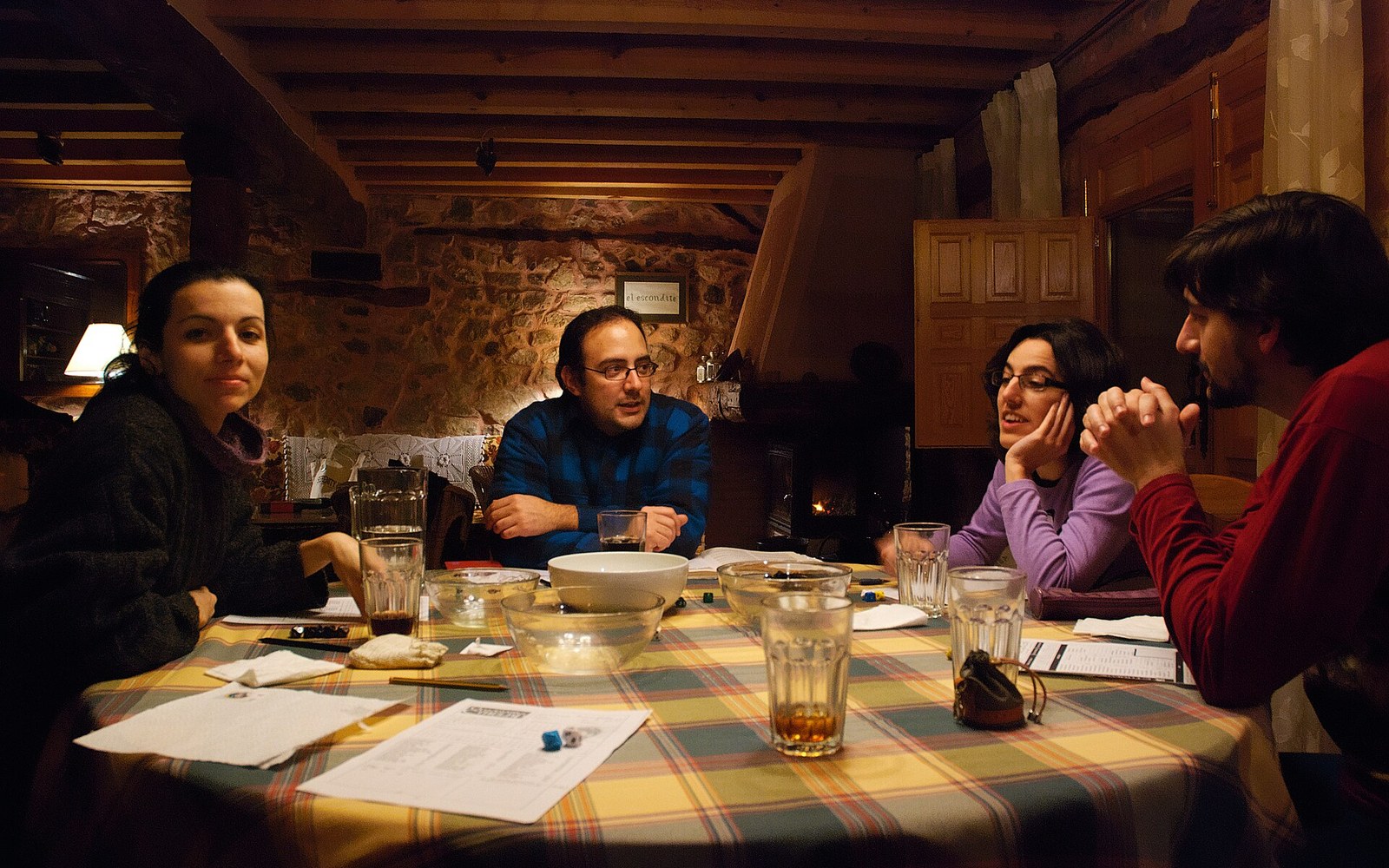
Four adults, one fiction, and no agreed procedure for deciding who may declare a thing true. Photo: Role playing gamers · Wikimedia Commons

Designers at the table.

Fellow travellers in the procedure.

Marks and names as they were given to us.

And with support from

Tabletop roleplaying began as an argument about a wargame. Dave Arneson put single characters into Gary Gygax and Jeff Perren’s Chainmail, and what was published in Lake Geneva in 1974 had no win condition, no board and no fixed number of turns. Everything since is an answer to the same problem.

Four sections. The longest of them is about dice, because the arithmetic is where the argument becomes visible — and because a table that knows its own odds behaves differently from one that does not.

Begin with the dice  →

03

What the dice are actually doing

All four pieces →

0%2.5%5%7.5%10%12.5% 3456789101112131415161718 the total rolled → 5% ON EVERY FACE OF A D20 12.5% AT THE PEAK OF 3D6 9–12 · 48% of every throw One twenty-sided die Three six-sided dice, summed chance of each total
Both shapes cover the same range, 3 to 18. Only one of them concentrates: the four totals inside the amber band take 48% of every throw of three dice, while any four numbers on a twenty-sided die take 20%.

d20 against 3d6

A twenty-sided die treats a 1 and a 20 as equally likely. Three dice almost always land in the middle. Same range of numbers, two different games.

The section’s longest piece

What the dice are actually doing

Why the shape of a roll — not the target number — decides how often something surprising happens at the table.

Start here

Dice pools: many small chances instead of one big one

Roll a handful and count the good ones. Failure feels different when it arrives in pieces rather than all at once.

Counting, not adding

04

The layer nobody notices

All three pieces →

Initiative, the exploration turn and the reaction roll are the parts of a rulebook nobody quotes. They are also what stops a session becoming a conversation with dice in it.

A game master's screen seen from behind with notes taped inside
Notes taped to the inside of a screen: the procedural layer, in the form it usually takes at a real table.

The layer nobody notices

Initiative, the exploration turn and the reaction roll are what stop a session becoming an unstructured conversation.

Section 4

The reaction roll

Deciding an encounter's disposition by dice removes it from the referee's mood, which is a deliberate transfer of authority.

Section 4

The exploration turn

A unit of time that makes resources tick — light, rations, wandering checks — and turns exploration into a system.

Section 4

A hand-drawn dungeon map on graph paper with a pencil across it
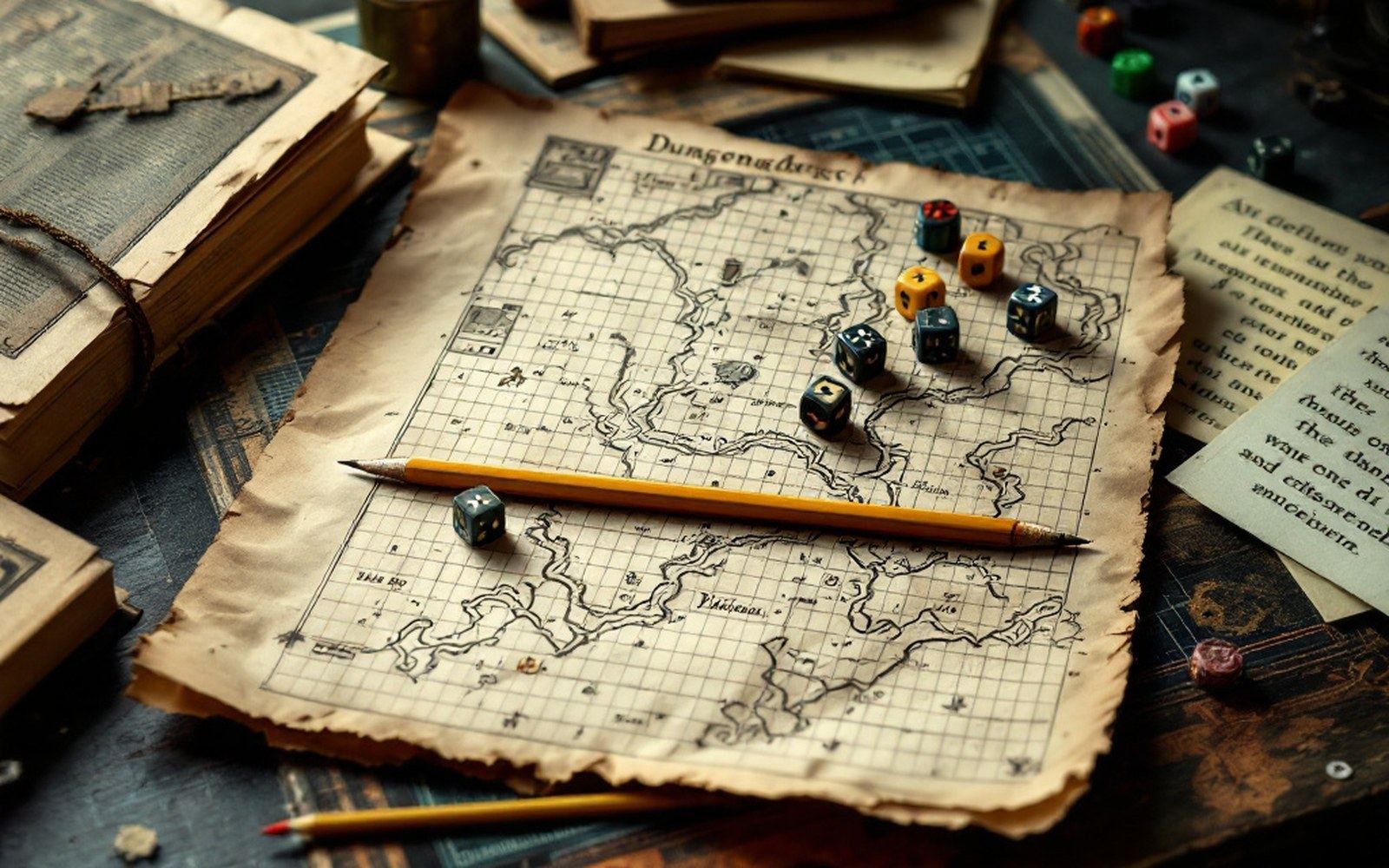
Rooms drawn before anybody sat down. A map made in advance constrains the referee as much as it serves the players.

Four evenings that changed what a rule was for

The whole sequence →

Dave Wesely handed each player one person in a Napoleonic town instead of an army, and spent the evening answering questions the wargame had no rule for. Dave Arneson was in the room.

1974

Lake Geneva

The dungeon campaign that put single characters into a medieval wargame and produced something with no win condition.

2010

Apocalypse World

A system built on moves and player-facing rules that rebuilt the procedural layer around conversation.

and back again

The OSR argument

Returning to the 1974 assumptions is itself a design position about where authority should sit.

Fourteen pieces, four sections. The full index · browse by section