What the dice are actually doing
What the dice are actually doing
A resolution system is a probability distribution with a story attached, and the shape of the curve decides how often the unlikely happens.

The mechanism is a curve
Every time a player picks up dice, the game is secretly running a probability distribution. The fiction around it — skill checks, saves, attack rolls — is the story. The distribution is the engine. Conflating the two is how arguments about "narrative" versus "mechanical" games tend to go wrong, because both camps are really arguing about curve shape and who reads the outcome.
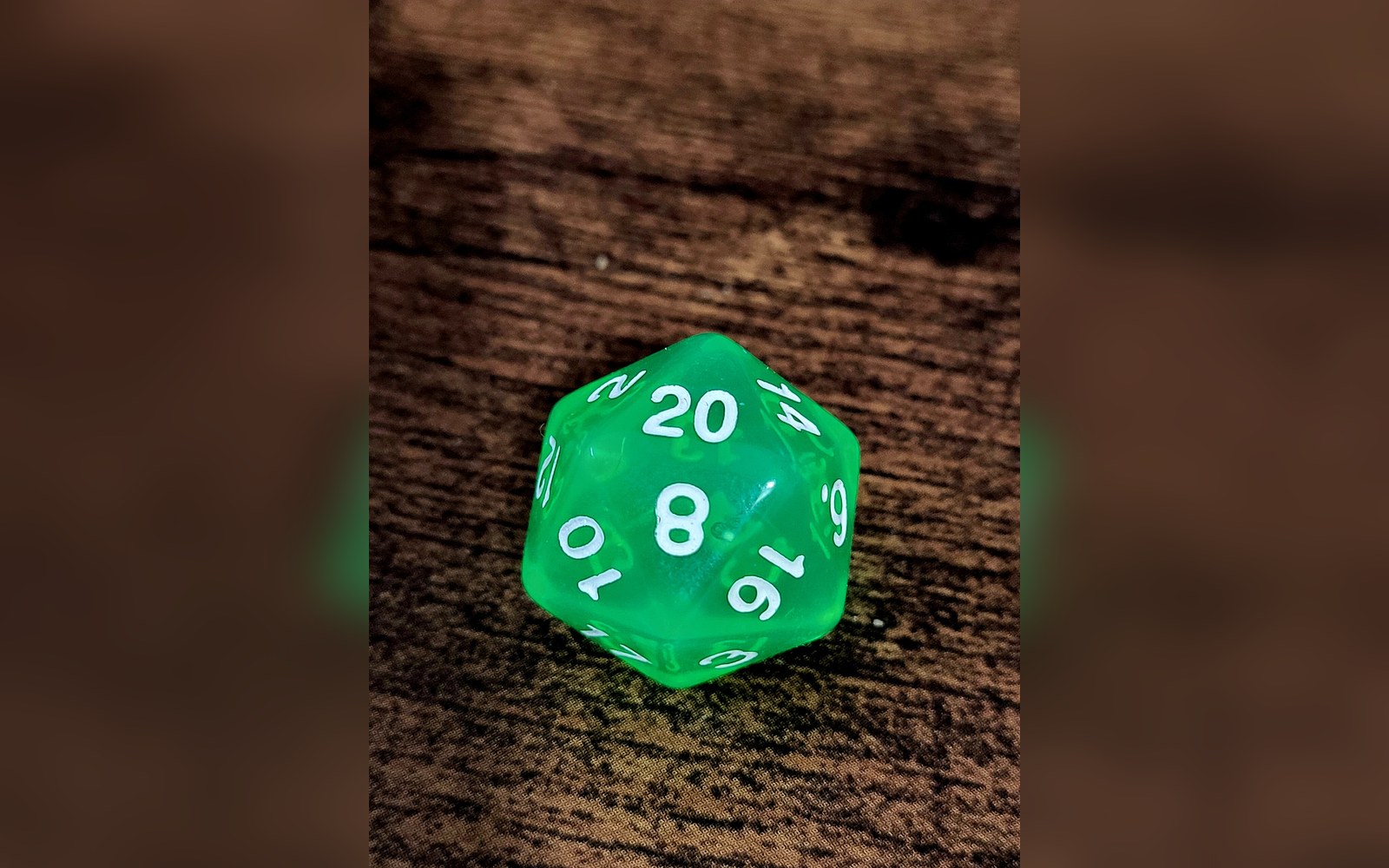
A single d20 produces a flat distribution: every integer from one to twenty has an identical five-percent chance. That flatness is a design statement. It says that a master swordsman and a raw apprentice are both one roll from catastrophe or glory; competence shifts the target number but not the texture of the probability. Modifiers push the distribution up and down the range without changing its shape, so the degree of advantage an expert holds over a novice can be measured precisely — a five-point skill gap is always a twenty-five-percent difference in success rate, no more, no less. This is the mechanical logic behind Dungeons & Dragons from its first edition onward, and it is not accidental: the earliest resolution procedures in that game grew from miniatures-wargame conventions where tabular lookup and a single die roll were the inherited vocabulary.
Roll three six-sided dice instead, and the distribution becomes a bell curve. Most results cluster around ten or eleven; results at either extreme are genuinely rare. The statistical difference between a flat and a normal distribution matters enormously to the table experience: on 3d6, the result that wrecks or saves a character against probability happens less often, and the middle range of outcomes — competent success, marginal failure — dominates. That is why Basic Role-Playing and the games it spawned tend to feel like stories about professional people making mostly sensible decisions with the occasional disaster, while d20 games can pivot violently in a single roll.
What the pool changes
A dice pool — a handful of dice read as successes against a threshold — produces yet another texture. The curve here is not symmetric in the way 3d6 is, and it is not flat in the way a d20 is. Pools are designed around a different question: not what single value falls on the die, but how many dice clear a target. The result is that failure comes in degrees. In a pool system, rolling zero successes when you needed three lands differently than rolling two when you needed three; both fail, but the second carries information the first does not. This is why pool mechanics are often paired with design philosophies interested in partial success and mixed outcomes — the mechanical shape supports the narrative intent.
What pool systems also do is make competence feel different. Adding dice to a pool produces diminishing returns in probability terms, because each additional die contributes less to the overall success rate than the previous one. This is the opposite of a flat modifier system, where each bonus point is identical to every other. A character in a pool game who goes from three dice to four dice gains real improvement, but not the same quantum of improvement as the character who went from one die to two. Expertise, in a pool, feels like reduced variance as much as elevated probability — the good character gets more consistent results, which is phenomenologically true in a way flat modifiers are not.

The authority embedded in the curve
All of this would be an exercise in applied mathematics if it didn't have consequences for who controls what at the table. But the shape of the resolution curve is inseparable from the question of who gets to say it happened.
A very flat distribution — high variance — transfers authority implicitly to the dice. Any result is plausible, so the dice are doing more narrative work than a modifier-heavy character sheet. The referee loses some interpretive latitude because spectacular outcomes in either direction arrive regularly and demand acknowledgment. Games that deliberately widen variance, or that strip away modifiers, are making a political decision about whose voice shapes the fiction.
A tight distribution does the opposite. When outcomes cluster toward the mean, the edges are special; failure is rare enough that it arrives as genuine rupture, and the referee or the system must have something to say about it that the middle range does not trigger. This is partly why the OSR argument — the return to the probability assumptions of the 1974 ruleset — is not merely aesthetic nostalgia. The original to-hit tables, the saving throws expressed as flat target numbers, the reaction roll read off a 2d6 curve: each of these carries embedded assumptions about variance and about the role of the dice relative to player decision-making. Dave Arneson's campaign, developed in Minneapolis before Gary Gygax formalized the Lake Geneva procedures, operated under conditions where the dice were arbiters of a genuinely uncertain world. Stripping modifiers back toward that model changes what the dice are for.
Reading the distribution as a designer
The design implication is that choosing a resolution system is not primarily a branding exercise — "we use a dice pool because it feels collaborative" — but a structural decision that downstream constrains every other choice. If the distribution is high-variance, the game needs procedures for handling dramatic outlier results without fiction-collapse: what happens when the master wizard fails the trivially easy spell, or the novice thief succeeds at the impossible safe? If the distribution is tight, the game needs to give variance somewhere, or sessions become predictable. Often this is where meta-currencies enter — bennies, fate points, plot dice — which are really external adjustments to the underlying probability distribution, buying a reroll or a bonus in exchange for a scarce resource.
The honest version of "what dice are doing" is that they are running probability distributions at a table that has agreed to treat the result as binding. The story is the frame. The curve is the commitment. Knowing the shape — flat, bell, pool, or something more exotic — tells a designer what the game is actually promising: how often the unlikely happens, how much competence matters, and where authority over the fiction ultimately lives.