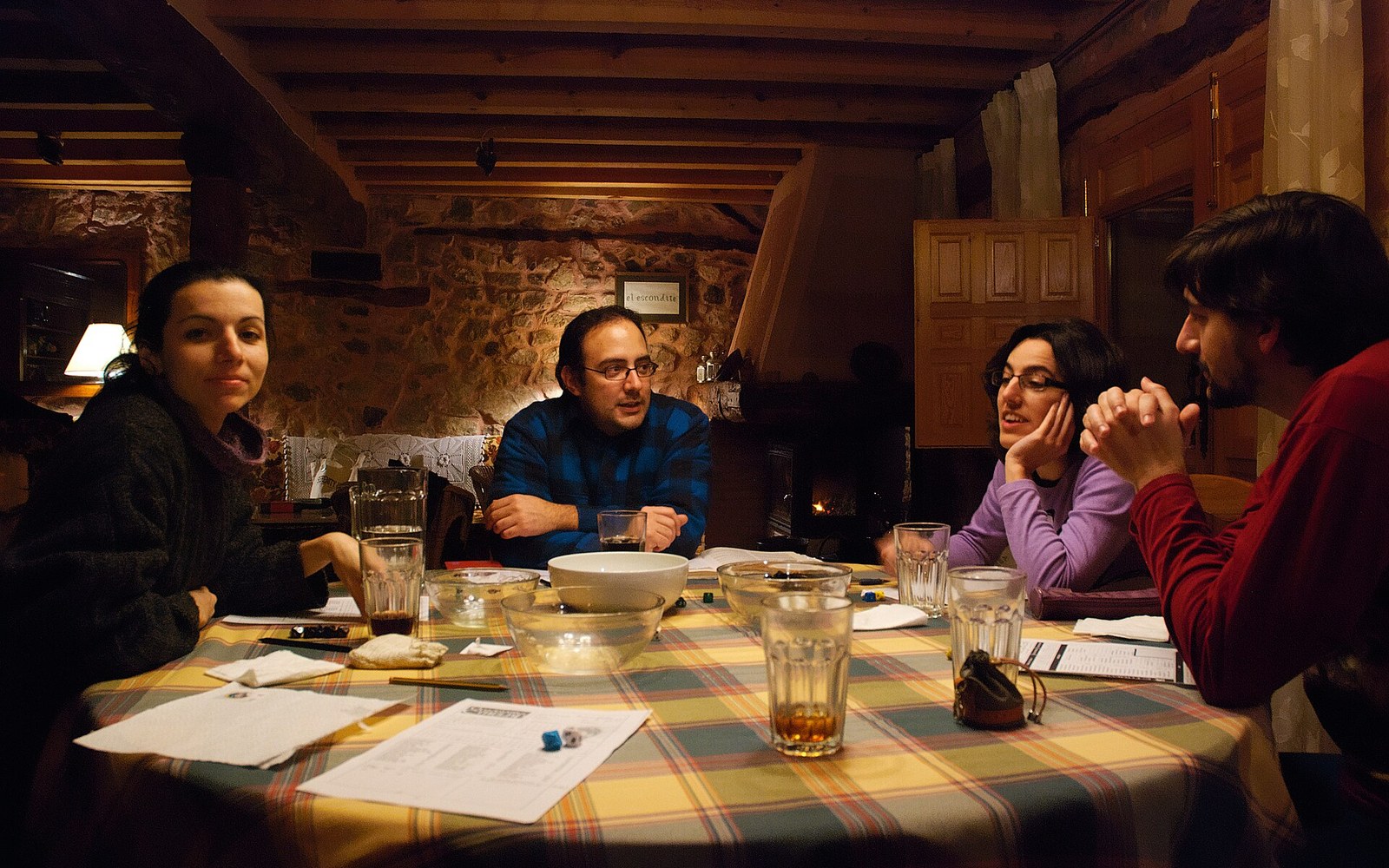
What the dice are actually doing
d20 against 3d6
Flat against bell: one makes every outcome equally likely, the other makes the middle ordinary and the edges rare.
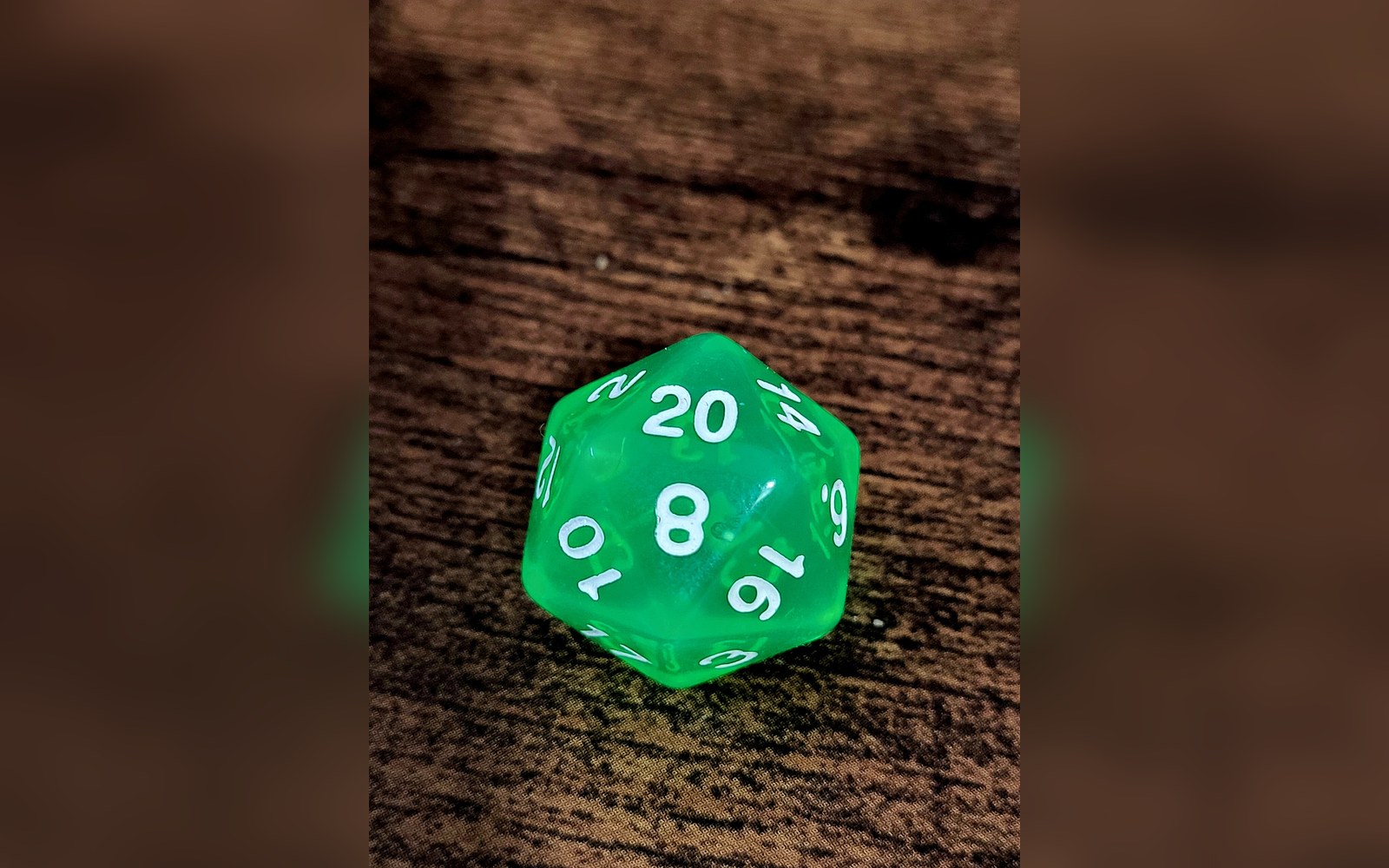
Two curves that answer the same design question differently
The d20 and the 3d6 produce numbers on overlapping scales — 1 to 20 and 3 to 18 — but their probability distributions are structurally opposite, and that gap is not aesthetic. It is a design commitment about what "ordinary" means at the table.
Roll a single d20 and every result from 1 to 20 carries an identical 5% chance. The distribution is flat: a 1 and a 20 are exactly as likely as an 11. Competence and catastrophe sit at the same probability as the mundane middle. Replace that die with three six-sided dice and the picture inverts. The minimum is 3 and the maximum is 18, but the curve peaks sharply around 10 and 11, each achievable by many different dice combinations. Rolling a 3 or an 18 requires every die to show its extreme face simultaneously — a roughly 0.46% chance each, against the 5% that any single d20 result commands. The middle becomes statistically dominant; the edges become genuinely rare events.
Both approaches emerged from the same moment and the same community. The wargame lineage that Dave Arneson was working from in the early 1970s in Minneapolis — before he brought his dungeon campaign south to Lake Geneva, Wisconsin and collaborated with Gary Gygax — already used multiple dice for troop-level resolution, where bell curves smoothed mass-action results. Moving to individual characters pushed the question of granularity differently: what probability model should govern a single hero's action?

What the flat curve does
The d20 resolves a check in the simplest computational terms: roll, add a modifier, compare to a target. The arithmetic is shallow, the outcome space is visible, and the modifier math is immediately legible. If a character has a +3 bonus, that is a 15% swing on a d20 — a meaningful but not overwhelming advantage. This transparency made the d20 an obvious fit for Dungeons & Dragons as the system scaled and accumulated modifier layers through successive editions, culminating in the explicit "d20 System" that Wizards of the Coast published under the System Reference Document in the early 2000s. With a flat distribution, every modifier point is worth a clean 5%, making stacking bonuses tractable to reason about even when there are many of them.
The cost of the flat distribution is volatility. Because no result is more likely than any other, a skilled character and an unskilled one sit closer together in practice than their modifiers might suggest. A character with a +8 bonus against a DC 15 succeeds on a roll of 7 or higher — a 70% chance. A character with no bonus fails on anything below a 15, but still succeeds 30% of the time. The flat curve never lets competence become reliable; the 1-in-20 catastrophic failure is always the same distance away. Designers who want to reward long investment in a skill and make true experts feel consistently expert have to work against the distribution, typically by removing dice entirely at high tiers or by adding advantage mechanics — rolling twice and taking the better result — which flattens effective variance at the high end without touching the underlying shape of the die.
There is also a structural consequence for drama. Because every result is equally probable, a d20 check cannot reliably signal that a trained character is doing something ordinary. A blacksmith trying to shoe a horse — a task they have done a thousand times — still has a 5% chance of a catastrophic 1. Many designers and referees address this by simply not calling for rolls on routine tasks, which is itself a design decision: the flat distribution forces a gating question ("is this worth rolling for?") that a bell curve answers differently.
What the bell curve does
The 3d6 model is primarily associated with GURPS, first published by Steve Jackson Games in the 1980s — and with the original attribute generation method in early D&D, which used 3d6 in order for the six ability scores. The bell curve's central tendency means that most results land near the mean, and the population of possible characters clusters there too. When attributes are the resolution axis, as in roll-under systems where a player rolls 3d6 and tries to stay at or below a stat, the shape of the distribution interacts directly with competence: a character with a 15 in a skill succeeds most of the time on routine tasks and fails reliably at the top of the difficulty scale, without needing the referee to suppress low-stakes rolls.
The Chaosium house style that matured through the 1980s and 1990s leans hard on this property. A character with a high skill percentage succeeds so often that the player internalises reliability; the dice produce drama at the margins, not in the middle. This is the opposite of what the d20 does. The probability distribution of summed dice is well understood mathematically, and its design consequence is that expertise becomes legible without designer intervention: the curve itself grants reliability to the skilled and denies it to the unskilled in a way no flat die can replicate.
The tradeoff is modifier arithmetic. Adding a bonus to a 3d6 roll shifts the mean but disproportionately affects the tails — a +2 modifier matters far more near the center of the distribution than at the edges, because the probability density is not uniform. Stacking modifiers in a bell-curve system is consequently harder to reason about and easier to inadvertently break, which is part of why the 3d6-resolution tradition generally kept bonuses small or absorbed them into the skill percentage directly rather than adding them at the roll stage.
The design choice underneath both
Neither distribution is neutral. Choosing a flat die or a bell curve expresses a position on what dice are actually for. The d20's uniform distribution makes every roll a genuine gamble regardless of preparation — it keeps tension high and competence provisional, which suits games built on the fiction of adventurers doing things at the edge of human ability. The 3d6's bell curve makes routine things routine and rare things genuinely rare — it suits games in which character skill should feel real and in which the statistical texture of ordinary life is part of the simulation argument.
This is why the choice between them is not really about arithmetic. It is about what kind of story the resolution layer is expected to support. A game in which an expert can fail spectacularly at their specialty every twentieth attempt is a different game from one in which experts almost never do — not because the rules say so, but because the shape of the dice says so. The modifier economy, the gating of rolls, the drama of a critical — all of it flows from the curve selected before any other rule is written.