Four evenings that changed what a rule was for
Braunstein
A wargame in which players were given individual characters and objectives rather than armies, and the session ran away from its own rules.
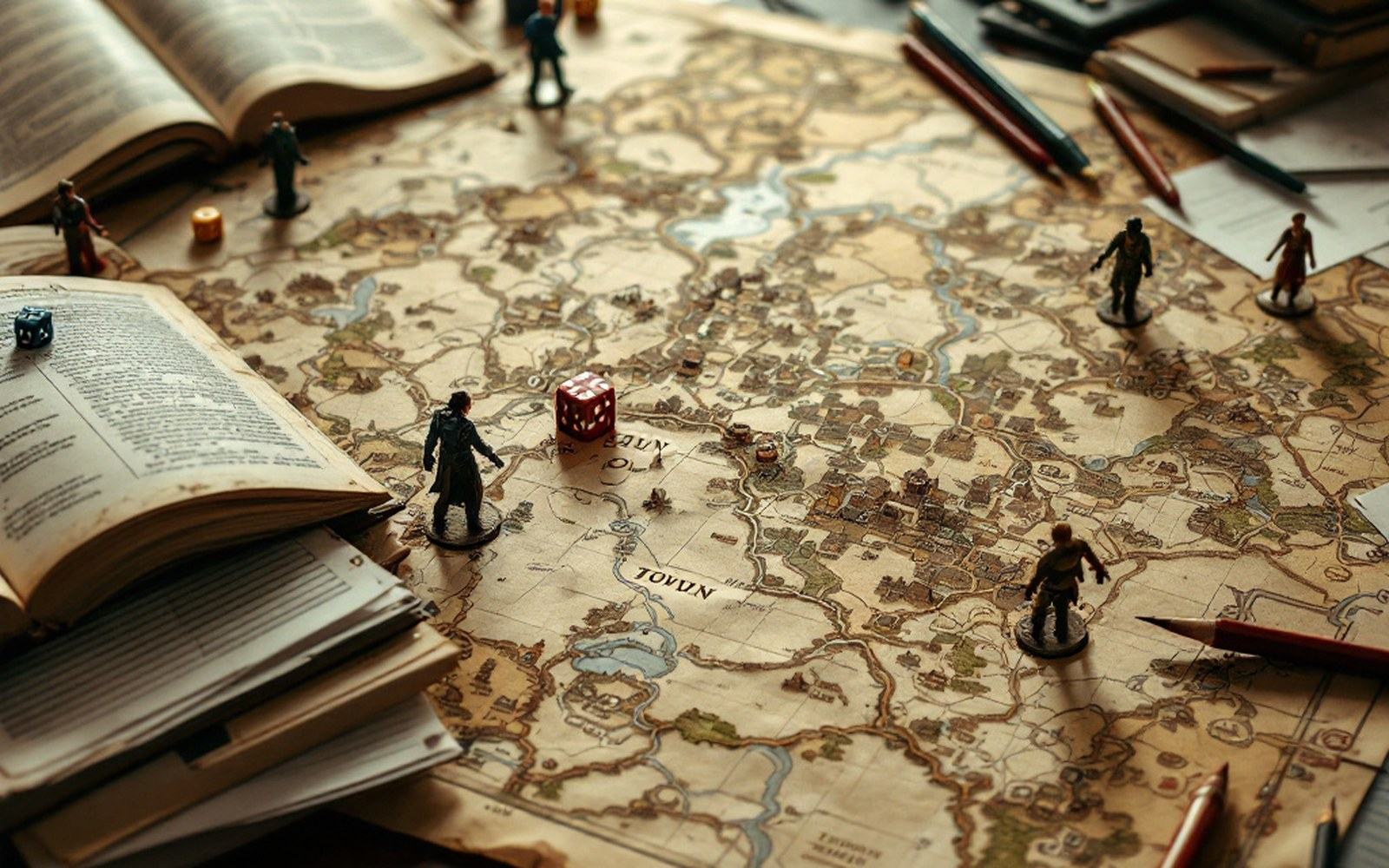
The night the game outran its rules
In the winter of 1967–68, a wargame referee in Minneapolis named Dave Wesely ran a scenario set in a fictional nineteenth-century German town. The game was called Braunstein — named for the town itself — and it was, on paper, a conventional miniatures engagement: two small armies, a map, a referee to adjudicate. What made it different was a decision Arneson made before the session started. Instead of giving each player command of a unit, he gave each player a single character with a private goal.
There was a banker who needed to protect his assets. There was a student radical agitating for revolution. There was a neutral professor who simply wanted to survive. The military action was still notionally the point of the scenario, but the players pursued their own objectives by talking to each other, by deceiving each other, by doing things that existing wargame rules had no procedure to resolve. Wesely, as referee, improvised rulings on the spot. The session ran away from its own rules in the best possible sense, and everyone came back wanting to do it again.
What the scenario actually broke
Braunstein's structural departure from conventional wargaming was not thematic — it was procedural. A miniatures game of the era assumed that each player's interests were unified with a side: you wanted your army to win, so every decision you made was in service of that single optimisation. Arneson's scenario introduced what can be called a plurality of agendas. Six or more players, each with incompatible private objectives, could not be mapped onto two opposing forces. The game's existing resolution structure — range, terrain, firepower — said nothing useful about whether a banker could bribe a soldier, or whether a rumour could spread through the town in time to matter.
The gap between what the players wanted to do and what the rules supported forced the referee into a position that wargame design had never really needed to formalise: the authority to invent procedure under pressure. That improvisatory authority is, in retrospect, one of the things Braunstein bequeathed to everything that followed. The referee became something more than an umpire of existing rules; the referee became the provisional author of new ones. This is the role that Gary Gygax and Arneson would eventually codify — very partially, and with deliberate looseness — in the original Dungeons & Dragons booklets, published from Lake Geneva, Wisconsin in 1974.
Character, agenda, and the session that teaches itself
The design insight at Braunstein was not simply "give players characters instead of armies." It was more precise: give players characters whose success conditions are not identical to each other, and let them interact in real time under a single referee who has incomplete rules. That combination — asymmetric objectives, social interaction, improvised adjudication — produces something emergent. Players begin doing things that feel natural to them and that the system has not anticipated.
This is why accounts of the session describe it as chaotic and joyful rather than broken. The chaos was not a sign of failed design; it was the signal that something genuinely new was happening. Wargames of the period, including the Napoleonic and medieval miniatures games that formed Arneson's milieu, were built to model events that had already happened or could plausibly happen in organised military terms. Braunstein introduced events that had no historical model — interpersonal deception, spontaneous faction-building, individual heroics disconnected from unit morale — and the rules simply had no grammar for them.
What the session taught itself was that the referee's improvised ruling was enough. The game did not collapse because the banker's bribery had no stat block. The fiction held because everyone at the table accepted the referee's authority to say what happened. That acceptance — not the dice, not the procedure — is the load-bearing element of the whole enterprise. Resolution systems are built on top of it, and Braunstein is where it became visible because it was briefly all there was.
The line from Braunstein to the procedural layer
The direct genealogy runs from Braunstein through several more sessions, some of which Arneson explicitly called Braunstein sequels, to his Blackmoor campaign — the dungeon-exploration game he was running before he brought it to Gygax, who then produced the first published form of D&D. That genealogy is well documented by historians of the hobby, including Jon Peterson, whose research into the origins of roleplaying games traces the Braunstein sessions carefully through primary sources.
What the genealogy reveals is that the procedures that eventually did get codified — initiative, reaction rolls, the exploration turn — were answering problems that Braunstein had exposed. How do you determine who acts first when every player has an individual agenda? How do you decide whether a stranger is hostile before the players announce what they intend? How do you structure time so that individual resource decisions accumulate into meaningful pressure? These are not problems that a unit-level wargame ever needed to solve, because units acted on orders and strangers were enemies by definition.
Braunstein made individuals of players, and then the design task became giving individuals a procedural environment that was robust enough to support their autonomy without requiring the referee to invent everything from scratch every time. The tension between those two demands — player freedom and procedural rigour — has never been fully resolved, which is arguably why the hobby keeps producing new systems. Every resolution mechanic is, in some sense, an attempt to formalise what Wesely improvised in that Minneapolis basement. Some systems lean heavily into the referee's improvised authority; others try to give the players themselves the tools to resolve their own actions without referral. Both positions are responses to the same originating event.
The session itself left no rulebook. That is precisely what makes it foundational. Braunstein is not a published game with an ISBN and a designer credit. It is a documented occasion on which the procedural layer of roleplaying — who decides, by what mechanism, and on what authority — was discovered by being needed. The rules didn't produce the game. The game, running ahead of the rules, demanded that someone build them.
Read next
More in Four evenings that changed what a rule was for · the full index