Four evenings that changed what a rule was for
Lake Geneva
The dungeon campaign that put single characters into a medieval wargame and produced something with no win condition.
A town that built a problem nobody could solve
In the winter of 1973–74, in Lake Geneva, Wisconsin, a small group of wargamers were doing something the hobby had no name for yet. They were not running armies. They were running characters — single figures with names and histories, descending into a dungeon that Gary Gygax had built beneath a fictional castle, using mechanics that Dave Arneson had developed the previous year in Minneapolis during his Blackmoor campaign. What they produced was not quite a game. It was a procedure without a terminal condition, and that structural oddity turned out to be the thing that mattered most.
Wargaming already had referees — figures who adjudicated disputed outcomes and moderated the space between what the rules said and what a scenario demanded. The referee role came out of umpiring, where somebody stood outside the conflict and kept it honest. What Arneson had done in Blackmoor, and what Gygax formalised for publication, was collapse the scale of that conflict down to one figure per player and then refuse to give the game an ending. A wargame ends when one side wins. The dungeon campaign as it emerged from Lake Geneva was explicitly structured so that no such condition existed. The dungeon grew. Characters returned. The referee repopulated and revised. The game's temporal structure — the exploration turn, the wandering monster check, the attrition of light and rations — kept the pressure on without resolving it.
The mechanism underneath the mythology
What the Lake Geneva sessions crystallised, and what the 1974 publication of Dungeons & Dragons by TSR carried into the world, was a set of interlocking subsystems that were not always recognised as design choices because they looked like common sense. The exploration turn — a ten-minute unit of fictional time tied to resource consumption — was a clock that ran whether or not the players were paying attention to it. Every move through the dungeon spent time; every spent unit of time triggered a check for wandering monsters; every check made torches meaningful. This was not flavour. It was the procedural spine of the whole enterprise, and it produced a texture of consequence that no single roll could have generated on its own.
The resolution system underneath all of this was comparatively crude. The original D&D combat mechanics borrowed heavily from the Chainmail rules that Gygax and Jeff Perren had published in 1971 through Guidon Games, a system designed for medieval miniatures combat at a scale of roughly twenty men per figure. Dropping to one figure per player did not fundamentally change the resolution architecture; it just changed what a hit point represented. The to-hit roll — a d20 against a target number derived from armour class and attacker level — generated a flat probability distribution, meaning every outcome across the die's range was equally likely. That flatness had a consequence: it made combat genuinely dangerous at low levels and only gradually less so, which aligned with the resource-management logic of the dungeon itself.
The reaction roll sat adjacent to combat rather than inside it. When characters encountered a creature that was not immediately hostile, a dice roll — modified by charisma and by circumstances — determined the creature's initial disposition. This was a small mechanism with a large structural function: it removed the encounter's opening state from the referee's improvised mood and gave it to the dice, which meant the referee's job shifted from deciding what was happening to adjudicating what happened next. Deciding an encounter's disposition by dice removes it from the referee's mood, and that removal was not incidental. It was how the dungeon stayed honest across sessions, across different referee temperaments, across the years of play that the campaign format implicitly promised.

What no win condition actually means
The absence of a terminal condition is not an oversight or a failure of design closure. It is the design's most consequential claim. Every prior game in the wargaming tradition that Gygax and Arneson were working inside had a defined end state: one side's forces destroyed or surrendered, a strategic objective captured, a scenario concluded. The dungeon campaign refused this. Characters could die — and in the early rules, death came readily — but the campaign itself did not end with a death. A new character entered. The dungeon remained. This structural choice produced something closer to a setting than a game in the classical sense, and it is why the word "campaign" attached itself so quickly and has never quite let go.
The implications for authority at the table were substantial. With no win condition, there was no external criterion against which to measure referee decisions. The referee was not moving pieces toward a defined resolution; the referee was maintaining a world. That is a fundamentally different kind of authority, and it is one that every roleplaying system since has been an answer to in one way or another — whether by constraining the referee's latitude through explicit player-facing mechanics, as later designs would do, or by expanding it through the sandbox assumptions that the Lake Geneva model licensed. The OSR argument, decades later, is largely an argument about returning to those original assumptions: that the referee's authority over a persistent world, checked only by the dice and the logic of the fiction, is the right answer to the authority question.
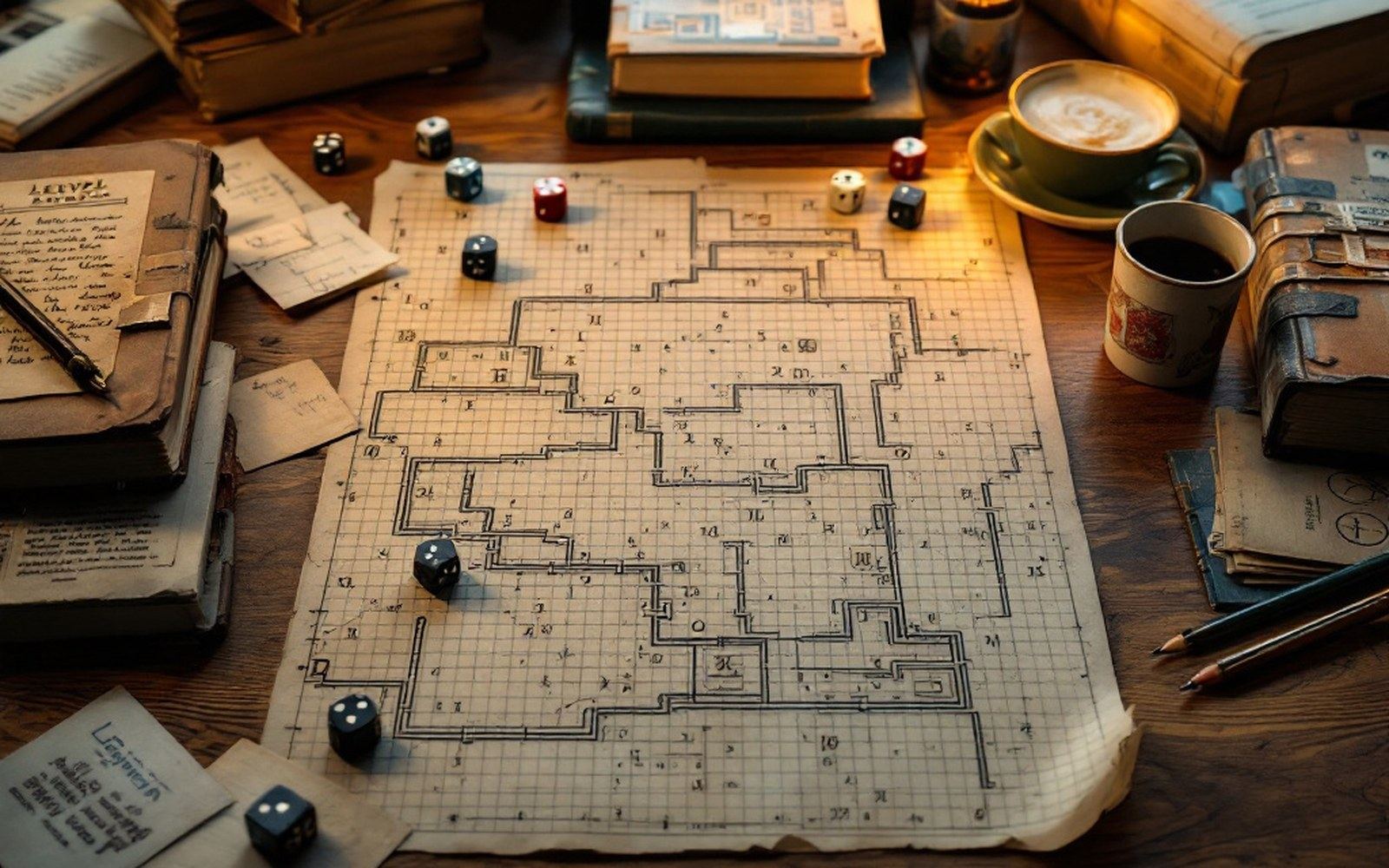
What Lake Geneva produced, then, was not a solved game. It was a solved structure — a procedure for generating ongoing fictional consequences from a shared set of resources, constraints, and probability distributions, with no built-in pressure to stop. The dungeon as a spatial form enforced that structure: doors meant decisions, corridors meant resources spent, the map itself was a record of choices that could not be undone. The wargame underneath it supplied the resolution mechanics. The referee inherited the umpire's role but gained a new one — keeper of a world that existed between sessions, described in published rules that sold tens of thousands of copies by the end of the decade and reshaped what it was possible to imagine a game being for.

Read next
More in Four evenings that changed what a rule was for · the full index