What the dice are actually doing
Roll-under, and the appeal of a number you already know
Testing against a stat the player already has removes a layer of arithmetic from every check.
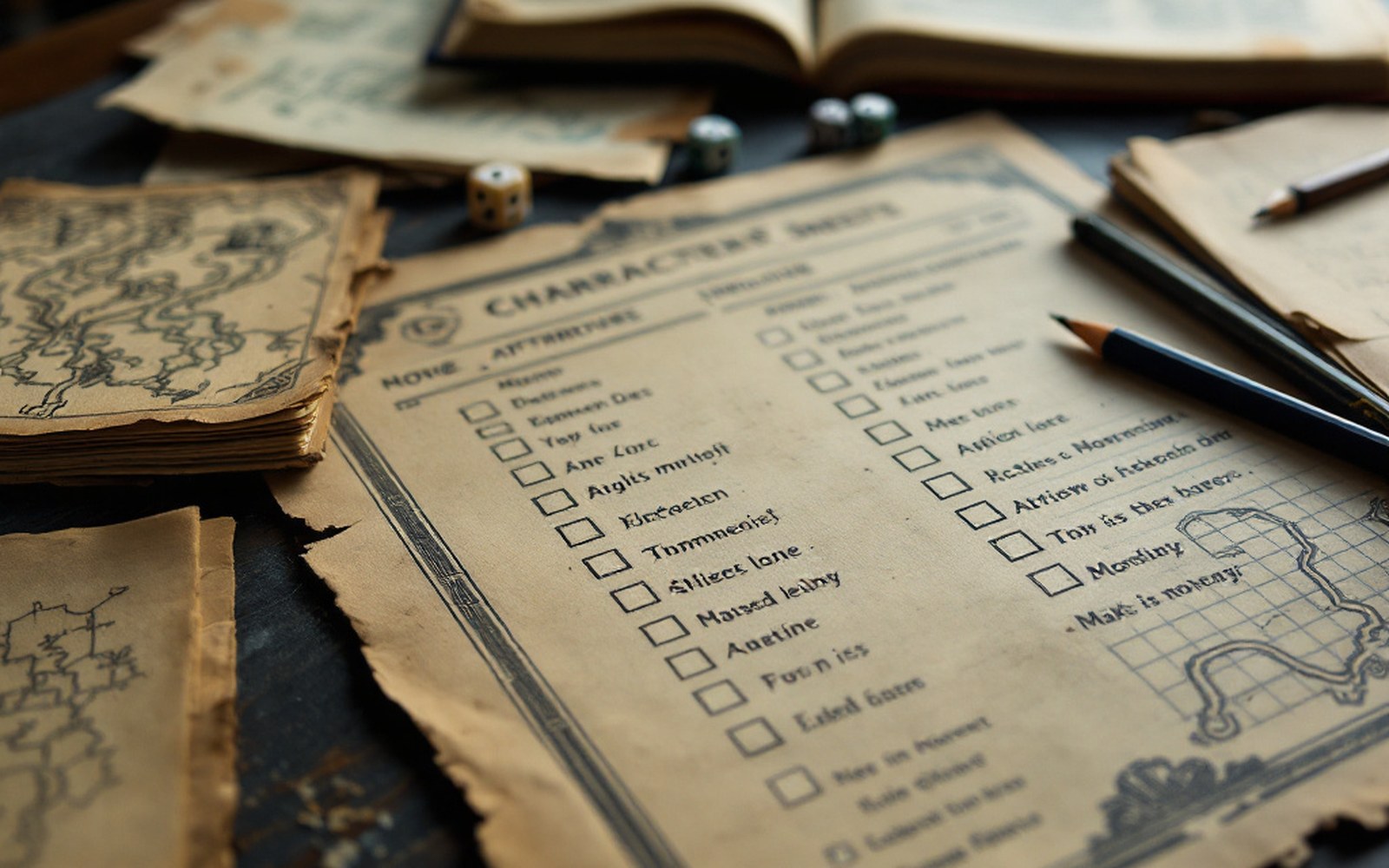
Testing against a stat the player already has removes a layer of arithmetic from every check.
The arithmetic problem that roll-under solves
Most resolution systems present the same basic transaction: roll some dice, add something, compare the result to a target. The variation is in what gets added and what the target is — and, hidden in that variation, a small but real cognitive cost. Before any outcome is known, the player must hold the die result, the modifier, and the difficulty number in mind simultaneously, perform the addition, and make the comparison. When modifiers are large and situational, that cost compounds. Over an evening of play, it accumulates into a kind of low-grade friction.
Roll-under removes the middle term. The attribute — Dexterity, Intelligence, Constitution, whatever the system calls it — is the target. Roll at or below it, succeed. The player already holds the target; it is printed on the sheet. There is no arithmetic, because the roll is the comparison. This is why the mechanism reappears across decades and across otherwise very different games: it is structurally economical in a way that no amount of polishing a modifier chain can replicate.
Early roleplaying's statistical DNA owes a considerable debt to wargame attributes, many of which were probability distributions built around a bell curve rather than flat dice. When Gary Gygax and Dave Arneson developed what would become Dungeons & Dragons in Lake Geneva, Wisconsin, the six core characteristics were generated by three six-sided dice, producing scores centred around 10–11. Testing against such a number with a single die produces a probability that tracks directly with the stat — a system-level elegance that later editions, with their ascending target numbers and bounded accuracy, traded away for a different set of priorities.

What the number actually communicates
The appeal of a number you already know runs deeper than speed. In a roll-over-a-target system, the target is often referee-assigned and therefore partly opaque; the player may not know whether a DC 15 is hard or routine until after the session. In roll-under, the player's own score is the entire probability surface. A score of 12 on a 1–20 range means a 60% chance of success. A score of 7 means 35%. There is no table lookup, no inference from context; the percentage is legible directly from the character sheet. This makes risk visible to the player before the roll, not reconstructed from it afterward.
That legibility changes the texture of decisions. When a player already knows their character's Strength is 9, they understand without prompting that forcing the gate is not favourable ground. The system communicates danger through the sheet rather than through referee narration, which is a meaningful shift in where authority sits. The number does not just resolve the check — it informs whether to attempt it.
The OSR movement, which since the mid-2000s has returned deliberately to early design assumptions, has made roll-under a recurring mechanism. The relevant mechanical heritage runs through Basic/Expert D&D, the B/X rules and the systems that descended from them, where attribute checks were often handled by rolling under the relevant score with 1d20. That procedure reappeared in games like Jim Raggi's Lamentations of the Flame Princess and in numerous retroclones. The OSR community's design writing has treated roll-under not merely as a nostalgic affectation but as a considered preference for mechanisms that do not interpose complexity between intention and outcome.
What roll-over gains in granularity — variable target numbers allow fine-grained difficulty adjustment — roll-under trades for immediacy. Neither is strictly superior; they represent different answers to the question of what the dice are actually doing inside a resolution system. Roll-under concentrates probability information in the character, making the sheet a live instrument rather than a record of construction. It is one of the clearest examples in tabletop design of a mechanism whose elegance is inseparable from what it removes.